Tuesday, July 10, 2007

Lancaster Canal

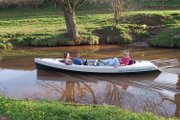
The Lancaster canal runs from Preston to Kendal. Only the Southern part is currently navigable but this includes a 41 mile lock free stretch which makes it an attractive proposition for Winsome.

As we needed to travel up the M6 in order to demonstrate Winsome to some folks on Lake Coniston, it seemed a waste to zoom straight past the Lancaster canal without sampling what it has to offer – especially as one gets tantalising glimpses of it from the motorway.

So, a few days before we set off, we tried to find where we could launch a 17 foot pedal boat for a day on the Lancaster canal. We found 3 slipways listed by British Waterways and called up all 3 to enquire about launching a day boat on their slipway. Unfortunately, we discovered that all 3 were owned and operated by private marinas and would charge us £30 for the privilege (£15 each way). It seems it’s cheaper to launch at the height of the season at Henley-on-Thames than on the Lancaster canal!

So, we contacted British Waterways to see if they could advise us on a means to access their canal for less than the cost of our annual BW licence! Sadly not. The BW staff we managed to talk to didn’t know of any public slipway. Once again we found that launching on canals as day visitors is not a recognised nor particularly welcome concept on many inland waterways.

But we are persistent, so Saturday morning saw us, map in hand, inching our way along the A6 (which runs alongside the northern end of the canal) trying to find possible launch spots. Thus we happened on the “Canal Turn” pub at Carnforth – we drove into their carpark, stepped across the towpath and there was a slipway! Not a great one but certainly good enough for us. We called the telephone number advertised on the BW sign nearby and spoke to a friendly official who didn’t know about the slipway but thought it probably belonged to BW given it was on the towpath side!

Carnforth Slipway

The only problem was where to park so we tracked down the landlord of the Canal Turn pub who was very friendly and quite happy for us to park and offload the boat as long as we patronised the pub which we were certainly very happy to do!
Launching was straightforward and with the added pleasure that the marina slipway (which we could see directly opposite) would have set us back by £30!

The first part of the canal running south from Carnforth is close to the A6 which makes it slightly noisy but not unpleasantly so. A sudden downpour might have dampened our spirits but the latest addition to Winsome’s onboard kit of two large golfing umbrellas means that such sudden showers no longer hold any fear for us.

Rain shower

Nearing Hest Bank, we encountered the Hatlex Swing Bridge. We moored alongside and both went ashore to investigate whether we could open the bridge and, if so, how. Having tried our BW key in the padlock and discovered it didn’t work, we then spotted we didn’t need to unlock anything, simply push.

So, the helmswoman nipped back to Winsome whilst the crew put their back into swinging Hatlex bridge open. Unfortunately, the conditions were extremely gusty and, in the absence of the considerable (and delightfully sociable) ballast usually provided by the crew, a gust caught the bow as I approached the bridge and swung Winsome hard around across the narrow canal. Without being able to get up speed (no room) and without forward ballast (no crew), she would not turn back into the wind. By this time, the boat had turned right around and I pondered reversing through the bridge but decided it would be easier to take her to the bank and rope her through.

If one is Winsoming any distance single handed, Nick has provided a forward chamber which can be filled with water to balance the boat and prevent this kind of thing happening. Unfortunately, we might need to find a very quick way to ballast the boat for these 2 minute solo trips through windy bridges at slow speeds.

On the return trip, the operation looked less risky due to having a following wind but, as there were a group of curious ramblers huddled on the towpath watching us, I took ballast on board (in the form of a helpful female rambler) for the short passage under the bridge. Unfortunately, one might not find such obliging well ballasted ramblers whenever one encounters such a windy solo moment. Food for thought.

Along the last mile of the canal entering Hest Bank, rows of houses of all sizes and ages run down to the canal.

House

Pedalling past such a creative variety of garden-ends and pontoons proved one of the more entertaining aspects of the trip. It was easy to spot whether the main interest of the residents was in boats, garden plants or simply sitting relaxing by the water.

quay

statues

On arrival in Hest Bank, we moored alongside and employed our new waterproof seat covers in case of further rain. These are simply elasticated rucksack rain covers and serve the purpose perfectly. We just wish they weren’t such a loud orange colour.

rain covers

Hest Bank runs to an excellent Deli sandwich shop and that served our lunch needs well. Bacon and Salsa, we discovered, is a combination worth trying.

After lunch, we explored another mile or so South of Hest Bank before turning reluctantly around and heading back the 4 miles or so to Carnforth and a welcome drink in the friendly Canal Turn pub.

If we can find other places to launch and recover on this interesting and attractive canal, we will be back.

Monday, July 02, 2007

The Grand Western Canal

Another forecast break in the monsoon and we set off for the Grand Western Canal, an isolated contour canal in Devon, running from Tiverton to the Somerset border. This canal was originally part of a grand scheme to link Bristol to Exeter and provide a more reliable route between the midlands and the south coast. The Grand Western Canal was the only part of this scheme built. It was completed late and way over budget, and never quite established itself before the railways came and took away its market. Although closed to boat traffic for 50 years, the section of the canal from Tiverton to Lowdwells was saved from landfill and is now run by Devon County Council as a country water park. As it doesn't belong to British Waterways, you need a separate licence.

The only public slipway on the canal is at Boehill, near Sampford Peverell. This is very near to Junction 27 on the M5 and Tiverton Parkway station. Tiverton itself is 6.5 miles away by canal, and there is no longer a railway station in the town itself. It is a small irony that while the railway killed the canal as a commercial transport system, the canal has been returned to life as a leisure facility and wildlife habitat.

Boehill Slipway

It was a very straightforward run down to Boehill along the M5. We bought a day licence for £3 and day parking for £1 from the Minnows Touring Park, a touring caravan site on the canal, although (as it turns out) not the actual slipway. We filled out the rather grand form and were duly issued with a paper licence "plate" to stick on the boat. We followed their directions to the slipway which is accessed down a narrow track. This would be a nightmare for someone towing a trailer if they ever met anyone. Fortunately, the track opens out to a very nice slipway area with plenty of room to turn round or, in our case, to unload and assemble the boat. It might not be so stress-free if the slipway was ever busy, and it will require some logistic skill for the canal to host the 2008 Trail Boat festival unless they are planning an additional slipway at the showground.

Once assembled and launched, one half of the crew set off eastwards back to the caravan site while the other returned to park the car there for a very reasonable £1 charge. We arrived at about the same time, turned the boat round, and set off westwards towards Tiverton. The promised break in the weather had not entirely materialised at this point, but the rain was losing some of its enthusiasm.

Sampford Peverell Church

By the time we had covered the short distance to Sampford Peverall proper, the rain had stopped and there was patchy sun. And it was starting to dawn on us what a really beautiful canal this is. The water is wonderfully clear, and the banks are lush with vegetation.

Overgrowth

The many fishermen we saw looked like they expected to catch something. There were kingfishers, and water lillies, and ... duck weed.

Weed Ahead

Weed Cutting

Duckweed has a bad reputation among boaters because you often find it on stagnant water, and such water tends to be impassable. But that's not because of the duckweed, which as far as we could tell was simply floating on the surface. As you can see, Winsome cut through it with no apparent effort. I'm guessing it isn't the duckweed but the fact that it hides underwater debris that accumulates on the relatively static water duckweed tends to colonise. In fact, there were no underwater obstructions we encountered, and duckweed is a sign of healthy water - which the Grand Western Canal certainly is.

About halfway between Sampford and Tiverton there is a canalside car park with a lifting pedestrian bridge. We think Winsome could be launched over the bank here, although the safety boulders planted by the CC to stop cars running into the canal would need to be avoided. The lift bridge is a recent construction on an older abutment, and is very finely balanced. You need to open its combination padlock (you get the number with your licence) and then reach up and pull down on the counterweight bar to lift the bridge onto a catch which holds it in the vertical position. When you release the catch, it drops down smoothly but alas not quite completely. This means you have to walk onto the partially open bridge to complete its descent, which is quite noisy - but fun!

Swinging on a Bridge

A swing bridge swung


We made good progress - our usual 4.1mph on the GPS - along the canal and under its many beautiful bridges. The bridges on the Mon&Brec are somewhat "rustic" by comparison, and I wouldn't mind betting that having so many bridges built with dressed red sandstone must have had some impact on the budget - that, and the late decision by the builders to avoid locks on this section of the canal. This makes it longer than it might have been to follow the contour where feasible, but incorporating costly cuts and embankments where it isn't. That, and the need to divert around the the rather fine house of the Bishoip of Exeter of the time to keep the canal 100 yards away from his doorstep. In the early 1800's, having a canal on your doorstep probably didn't do a lot for property prices. In 2007, of course, everyone wants to be close to the water, provided, of course, that doesn't mean being regularly inundated.

Bridge and Helm

So in about 2 hours we arrived at the canal terminus at Tiverton, which is some way from the town centre (actually at the top of a hill). It's not clear the canal builders expected this arm of the canal to go much further in this direction. At the terminus there is a visitor centre, a floating canal shop (closed when we got there) and a ranger station on the other side of the canal accessed by an intriguing self-operated ferry.

Tiverton Basin in the Rush Hour

Rope Ferry

There was also a horse-drawn trip boat, with horse waiting to go. Below the canal at the terminus is a car park and a delightful thatched tea room offering exactly the kind of "light lunch" we were up for after our morning cruise. Not even an unconvincing rain shower could spoil this.

After lunch we returned to the basin to discover that the horse-drawn boat had gone. Hoping we would have no trouble passing her, we set off ourselves. We were surprised to find that it took about a mile to catch the trip boat, and when we passed her the horseman said they reckoned to cover about 2.5 miles in an hour. We would have been gaining on her, therefore, at about 1.5 miles an hour.

The Horseboat's Ass

The Horse

We stopped on the way back to examine some of the many water-lily colonies. We had learned from the guide book that, when the canal was under threat in the early 1960's, there was a water-lily business harvesting these delightful plants for wreaths!

Lilies After Monet

We arrived back at Boehill with enough time to spare to explore the upper reaches. The ranger had warned us that the vegetation in the eastern half of the canal might be more obstructive, but what prompted us to turn back was a family of swans with cygnets. We had already made the mistake of splitting a swan family, and this does not go down well. In any case, we'd done our 15 miles for the day and needed to recover the car and get the boat out. This was done with consummate method and skill, and we were on our way in 20 minutes - just in time to join a 20 mile traffic jam on the M5.

Wednesday, June 27, 2007

Eco-Dining

Our penchant for heading off in Winsome to a nearby pub for an evening beer after work has evolved into a penchant for Winsoming for pub suppers. On a fine June evening (not that we’ve had many), there’s something really satsifying about travelling by water a couple of miles to a country pub, consuming an excellent chilli-con-carne with half chips and half rice swilled down with a bottle of Shiraz and then heading home at an even-more-laid-back-than-usual pedal rate watching the evening light over the Brecon Beacons. And no petrol consumed.

Beacons

Living in Pencelli, we are fortunate to have excellent pub suppers on offer 2.5 miles away (by water) in both directions.

Last night, we favoured the Three Horseshoes at Groesffordd (we particularly like their chilli!). This means a pedal down to Brynich Aqueduct where we can moor Winsome and trot up the road to the pub.

When there’s shopping to be done, we head on through Brynich Lock for Brecon (another 2 miles on). Unfortunately, although this is the only lock between us and Brecon, it’s not a Winsome-friendly one. The photo shows the fierce outfall at the entrance to the lock which can easily slew the bow and then (whilst you are still recovering) the stern into an inhospitable stone wall.

Outfall

This is made worse in our case by the fact that the crew has usually been dropped off to go open the lock which means Winsome’s bow is somewhat lighter in the water and not offering its usual grip. The helmswoman is also not in a useful position to fend off the bow when entering the lock. Winsome’s hull is certainly tough enough to sustain any such bang but it’s not a comfortable experience.

After one or two near misses, we’ve taken to dollying around this particular lock rather than going through it. Fortunately, that takes us less than 15 minutes, i.e. much the same time as going through the lock.

Last night though we watched a hefty narrow boat coming through the lock and winced as even a boat as heavy as that was pushed sideways by the outfall and hit both bow and stern against the rough stone wall.

I was therefore amused to discover that Brynich Lock has won British Waterways’ award for “The Best Lock in Wales” on 3 separate occasions – the announcement (for 2005) reads “Brynich Lock was in tip-top condition for the judges' visit. With safety of paramount importance, a non-slip surface was fitted to the footbridge over the lock, additional safety rails were installed and mooring bollards were relocated. Various parts of the lock were repainted using environmentally-friendly, water-based paints, and visitor information around the lock was improved. Neatly-trimmed grass, carefully-tended borders and colourful hanging baskets further enhanced the surroundings.”

I can’t help wishing that the judges had paid slightly more attention to the effect on boats of the lock’s outfall than they did to the “carefully tended borders and colourful hanging baskets”.

Anyway, after a hot chilli and a bottle of Shiraz, we weren’t in a mood to worry and we turned Winsome around...

Turning

...and headed off home observed only by some grazing cows.

Cows

Tuesday, June 19, 2007

Bristol Harbour

Sunday 17th June, 2007, signalled a change in the weather from monsoon to simply overcast. It wasn't settled enough for a long trip, so we decided to "do" Bristol Harbour. On the map this looked good for a short jaunt - no great distance, but plenty to see, and other things to do if the forecast proved wrong. Winsome was loaded up, we set off and arrived at Bristol Marina about 90 minutes later.

The marina is to the west of a large boat-yard and the S.S. Great Britain, on the southern side of the harbour. They have built a lot of houses here in recent years, and there are frequent water buses and ferries to the town centre and beyond. This end of the harbour also sees a lot of water sport activity, and there were dragon boat races between the marina and the seaward end of the harbour.

We were anxious, as one always is on trips like this, that we might not be able to park somewhere quiet enough to get the boat off yet near enough to the water for us to launch. Bristol Marina proved outstanding in this respect. There is a double slipway with ample floating jetty space for mooring along side after launch, and a barrier-controlled car-park for slipway users. This was all included in the £7.50 launch fee which includes the necessary day licence to use the harbour. This probably compares favorably with a long stay car park in the city centre!

We bought our licence from a very helpful lady at the marina office and found a quiet corner of the car park to unload and assemble the boat. We were on the water 30 minutes after arriving.

Marina SLipway

Setting Out

Bristol has a "floating" harbour held at high tide level, so boats float all the time. The tide rises up the river to a point where you can get out to sea for only a relatively short period each tide, but quite large boats can still make it right up to the centre of Bristol. Historically, the city was built around its harbour and it is still a focal point even though Bristol has not been a major commercial port for more than 100 years. Unlike Cardiff, a major commercial port in more recent times, Bristol still "faces" its harbour. As you proceed out of Bristol city centre up the river you can still find "backside" water frontage, but even this is slowly being converted to, or replaced by, homes and offices that face the water. This is good news for Winsome, and for residents and office workers in central Bristol.

Bristol Harbour Map

Also good news in terms of exposure are the large numbers of visitors. Bristol Harbour is a tourist destination with waterborne activities and waterside attractions such as museums and art galleries and the @Bristol exploratory, the S.S. Great Britain and the replica of Cabot's Matthew, theatres, cinemas, cafes, restaurants, pubs and shops. There is ample mooring in the city centre for visiting craft, and there is clearly a substantial resident population living on boats moored in the harbour. And these boats are not, in the main, "posh" - some are quite old and battered, but even the new ones can be interesting.

Because of the dragon boat races, we decided to head "upstream" to the town centre to see what we could find. Looking at the map, we didn't expect this to take very long, but it did. There were two reasons for this: firstly, there is a great deal to see, and secondly the harbour, the river and its feeder canal are much larger and longer than we thought.

We noticed at the outset that we were going much more slowly than we usually do. Rural cruising offers more spectacular scenery, but it changes slowly, so there can be long stretches where there isn't much new to see. In Bristol Harbour, there is something new to see every few yards, and the best place to see it is from the water. We're not very conscientious photographers (you may have already noticed that) but we took more photographs in a couple of hours in Bristol Harbour than we normally would in a month. You'll be pleased to learn that most of them suffered from the poor light and poorer technique, but the fact that we are resolved to get a more up-to-date camera as a result of this trip says a lot.

There are ferries and trip boats plying up and down the harbour, and we noted that some of the newer water-facing offices have jetties to supplement the frequent public water bus-stops. You can well imagine Bristol residents commuting to work at a waterside office in the city centre from one of the residential developments at the western end of the harbour or even, perhaps, from house along the Avon to the east of the city. We haven't seen what the place is like after dark, though, so perhaps getting home from the pub or restaurant after work is more difficult.

Just east of the marina slipway is the marina itself which has extensive moorings for boats that can in principle make it out to sea. We wondered how many of them ever do. In Cardiff Bay, the commodore of one of the yacht clubs reckoned only about 30% of his members ever went through the barrage locks, but Cardiff Bay does provide some sailing area. We guessed that sea trips would probably not be very frequent, if only because it would take a while to get to Avonmouth anyway, and we doubt you'd be able to make a day trip of it.

The next major attraction upstream is the S.S. Great Britain centre - the huge 6 masted ship has its own dry dock and a substantial visitor centre. It was a backup destination for us if the weather broke, but it didn't. All we have are photographs.

SS Great Britain

Beyond the Great Britain on the south side of the harbour are what remains of the working port. There are railway tracks and cranes, but there are also ice-cream stands, a couple of cafes, some loos (with a jetty) and an industrial museum. The high harbour walls give you some idea of the size of boat that was formerly serviced here, and there are some sizeable residential boats. A small boat like Winsome can only land at a few places where there are steps down the water or where there is a jetty. On the north side there is a lot more office and premium residential building, but the same high quaysides predominate. There are, however, some pretty spectacular houseboats moored on the north side. A couple of these were based on what had been fairly sea-going hulls, but I doubt they would now survive anywhere other than secured to a dockside in the floating harbour.

Loo and Poop

Trawler

Even in the city centre, the quaysides are "ship" height, but there are now more floating jetties, some of them accessible to visiting boats like ours, other private moorings protected by security gates. We cruised up past the Watershed building to where the original harbour has now been filled in. We'd never seen the cascading water feature from the water before.

City Centre

This water cul-de-sac is bounded on all sides by eating and drinking places, as well as arts centres like the Arnolfini. We executed a controlled u-turn to the evident delight of the crowd, and returned to the main drag. Turning left under the swing bridge we now proceeded further up the river past floating restaurants and shops.

We made a short detour down to Bathhurst Basin, which must once upon a time have provided another exit point from the floating harbour to the river Avon beyond, but now offers a rather fine marina and residents' moorings for the housing that encircles it.

Bathhurst

Emerging from the basin we turned right to pass under Bristol bridge and pass the old castle park. This would be a good place to stop if you were on a shopping expedition, being the nearest point to the main shopping centre. Above the castle park, the river is closed in on all sides by former dockside warehouses with no obvious quayside where goods were presumably hoisted directly into the buildings. Some of these buildings are now derelict, but others have been or are in the process of being converted to apartment blocks or new offices. There are also some completely new buildings which take more advantage of their waterside location. Whereas the old industrial buildings often present a blank wall to the water, the newly-built ones are clearly making the water an attractive feature. With luck, this will generate demand to make the waterway itself more attractive. In these upper reaches of the harbour there are still a large number of houseboats, but more of these were now conventional canal narrowboats rather than boats that might once have gone to sea.

Development

Bristol is several miles from the mouth of the river Avon, at its (original) lowest crossing point. The river is tidal well inland of the city, but the rise and fall of the tide in the Severn estuary probably made Bristol even in its heyday quite hard work as a port. You'd probably need help coming up the river on the tide, and you'd dry out between that tide and the one on which you left, but the port would at least have been sheltered with decent road access to the midlands. The floating harbour was built around the turn of the 19th century, and required diverting the river to the south of its original course, and putting a couple of big locks on the original channel which opened only at high tide. Netham weir on the Avon to the east of the city maintains the water level in the floating harbour. It also marks the start of the Avon navigation up to Bath from where you can take the Kennet and Avon canal through to Reading and the Thames. Bristol is therefore a canal terminus as well as a sea port, which is presumably why there are so many narrowboats.

As you cruise up the floating harbour into the eastern side of the city, and under the railway bridges at Temple Meads station you are abruptly diverted left onto an artificial "feeder" canal that re-joins the river Avon at Netham. We had already decided to turn round at this point, rather than go through the lock, but when we got there were puzzled to see that the lock was open, and showed no change in level to the river beyond. So it would have been easy to go through and travel the further 4 miles up to the first "proper" lock on the Avon navigation at Hanham. We later learned that Netham lock only closes when particularly high tides on the Avon rise above the level of the weir. In other words, Netham lock and its accompanying weir are designed to preserve the water level in the floating harbour. I guess the sea locks at the Western end of the floating harbour also have to be kept shut at the top of spring high tides for the same reason.

Netham Lock


So we turned round and retraced our wake back to the city centre for a cup of tea and a bun at the Arnolfini before returning down to the seaward end to observe the dragon boat racing at closer quarters. Here we spotted and explored a fine residential development at Pooles Wharf which appeared to have residents' moorings and a rather fine dutch barge.

At Arnolfini

Dutch Barge

It was now nearing 4pm and although the marina offices close at 4, we had been issued with the keycode number to exit the car park. However, just to be on the safe side, we decided to call it a day and proceeded to the slipway to haul the boat out. This was fairly straightforward, although the slipway is somewhat steeper than any we have used before. It's possible we might have been able to recover Winsome directly onto her dolly, but we used the boat roller just in case. We rolled her back to the car park, stripped her down, and were on our way by shortly after 4.

All in all, a great day out and we would have set off earlier had we realised the weather would hold and that access to the river above Netham would be free. We'll do that next time. A final note that struck both of us was how friendly everyone was at Bristol. The marina office couldn't have been more helpful. The harbour master was very welcoming and the numerous ferry and trip boat skippers who passed us all smiled and waved as they went by. The rowing club safety boats supervising the dragon boats were very engaged and engaging, and we had pretty positive interchanges with everyone we met. It must be something in the water.

Sunday, June 03, 2007

Exploring Cardiff Bay

Winsome last visited Cardiff Bay on blustery, wet day in February in order to provide a photo call for the Welsh Assembly’s Waterways Group.

We made a mental note at the time to return in more clement weather to explore the Bay properly. The forecast on Saturday was good so we set off for the Riverside Leisure Centre in Cardiff which (we’ve discovered) is an excellent place to launch and park for the day for only £6.

Leisure centre

Our only challenge on Saturday was the large fleet of kayakers – those in the water were no problem but the empty ones covering the entire jetty made it tricky to bring Winsome alongside after launching.

The map of the Bay below shows our passage marked in red.

Cardiff Bay Map

Half an hour after arrival, we were afloat and pedalling up the River Taff (away from the Bay) in order to view the Millennium Stadium from a novel angle.

Stadium approach

Wales’s football team were playing the Czech Republic which meant we got heckled by large numbers of seriously inebriated red-shirted soccer fans (“Oi, the sea’s the other way mate!”) and peered at suspiciously by the police and security guards parading the Millennium terrace.

Below stadium

Unfortunately, the height of the stadium terrace above the water means that Winsome would probably not be a good alternative for attending International rugby matches. But the novelty of the idea was briefly appealing.


Having exercised a languid U-turn at the main road bridge above the stadium, we had the added treat of hearing the strains of “Mae Hen Wlad Fy Nhadau” as we pedalled our way back past the stadium at precisely 3pm.

Next we headed out of the Taff and round towards Mermaid Quay skirting the outer moorings of the Cardiff Yacht Club. In the Force 4 conditions in February, this stretch of water was memorably rough but we were surprised at the amount of swell across this same stretch on Saturday when the wind was only 2 or 3 at most. At first we blamed the washes of passing Aqua buses and trip boats but the swell persisted for about ½ mile until we rounded the corner towards St David’s Hotel. We wondered if it’s some effect of the current out of the River Taff meeting the still (supposedly) waters of the Bay?

Our hope to impress the patrons of the St David’s Hotel (seated on the balcony for afternoon tea) was slightly dented due to a piloting oversight which meant we grounded briefly next to the wetlands just short of the hotel. A judicious spot of paddling (rather than pedalling) and a slightly heated exchange between helmswoman and crew put this event behind us and we pedalled gracefully into a berth at Mermaid Quay’s very fine ‘Pay&Display’ jetties.

Py&Display

We were particularly delighted to find ourselves alongside a very old wooden Wayfarer complete with rowlock fixed on the stern for sculling. Unfortunately, there was no sign of her crew.

Having paid at the ‘parking’ meter, we enjoyed a brief trip ashore to sample the benefits of city centre life (toilets and ice creams in our case). Mermaid Quay was heaving with city folk enjoying the sun and water and, after 10 minutes of city living, we were glad to escape back to the boat.

Mermaid Quay

After executing a neat stern board exit from our pontoon (which, unlike our grounding, was probably witnessed by nobody), we headed back out into the Bay.

Crossing the main part of the Bay to the barrage was uneventful apart from a couple of bright yellow, high speed RIBs stacked with paying punters screeching with delight at each high speed circuit executed rather closer to us than we would have liked. Watching Winsome bobbing around in their (repeated) wake was probably considered part of the entertainment for the punters. It was less entertaining for us and we guessed that the few small boats sailing found them as irritating as we did. It made us wonder, on such a small stretch of water, how the various very different water-based interests can be amicably (and safely) accommodated. Fortunately, as long as we kept up a good cruising speed and turned bow into the worst of the washes, Winsome took it all in her ladylike stride.

There were plenty of navigational disincentives to inspecting the barrier close up but we enjoyed watching the gates and road bridge open and numerous boats entering and (best of all) the two high speed RIBs boats disappearing through them and out to sea.

Opening barrage

Pedalling past the barrier, we entered the River Ely and passed a Drascombe Lugger drifting lazily in the light and variable winds. The helpful crew told us that we would be fine to explore up the River Ely for several miles until we reached a weir. So, on we went. Either side of the river are new executive riverside apartments – we were hailed with a question by one resident from his balcony high above us but couldn’t identify which balcony it was (there were so many) so the question went unanswered.

Ely Des Res


We noted (with regret) that the apartments offer fantastic balconies overlooking the river but no means for residents to land or keep boats. What a shame.

No mooring


Leaving the housing developments behind, the contrast of the quiet, almost rural river, after the hustle and bustle of the Bay was delightful. We encountered only two other boats and spotted herons and grebes. You start to feel you are miles into the country until the next bend reveals a deserted gasworks or dual carriageway flyover droning overhead.

Pumping station

An unexpected treat was a line of 5 classic old sailing boats (an original Cardiff Bay racing fleet we wondered?). They were in a poor state of repair but had beautiful, old fashioned lines and we just hoped that someone has the funds and plans to renovate them.

5 classic boats

Although the upper reaches of the Ely beckoned (“let’s just see what’s round the next bend?”), we had to keep an eye on the clock and reluctantly turned for home. The Channel View leisure centre had been anxious to point out that they close up shop (and slipway presumably) at 7.30pm.

We made fast progress back down the Ely and the final leg back up the Bay into the Taff and back to our launch point. 3 or 4 cruising boats returning from a day out beyond the barrage motored home past us and commented on Winsome. A friendly steam launch also chugged by and waved. It was nice to chat to passers by not in narrow boats for a change!

Steam Launch

Back at the leisure centre we quickly recovered Winsome, stripped her and had her on the roofrack and ready to drive home in under half an hour.

So, another area of Britain’s intriguing waterways has now been “Winsomed”. Bring on some more.

Monday, May 21, 2007

Sunny Sunday lunchtime run to Llangynidr

Yesterday was a lovely sunny Sunday morning and a good forecast for the day. Llangynidr for lunch, we decided – a 10 mile round trip from Winsome’s “home port” of Pencelli.

We hastily packed all the gear: sunhats, drink, lunch, monster torch and horn (for navigating the Ashford tunnel), The Sunday Times (for the crew to read during the more leisurely stretches of the canal) and portable radio (for keeping up with England versus West Indies test match at Lords). And off we go. Heading Home

Between Pencelli and Talybont-on-Usk (our regular evening pub run), there are 3 drawbridges. Only one of them gets left down in the summer and, fortunately, it’s one that we’ve recently discovered we can shoot (just) if we get both heads (and knees) down to gunwale level – mistakes in height assessment can be painful and the crew needs implicit trust in the helmsman for the signal to “Duck now”!

After Talybont, the next challenge is the 375 yard Ashford tunnel which is very narrow and has no towing path. Apparently, the horses were originally led over the top whilst the boat was legged through. The first photo gives a feel for how dark it is once you are inside. Ashford tunnel

Winsome’s regular helmswoman discovered early on that keeping a straight and steady course through a pitch-black tunnel was not her forte and to retain domestic harmony, she now hands control to Winsome’s tunnel pilot who has turned the practise into his own specialism. You can see him in action here complete with torch. Tunnel pilotThe regular helmswoman (now crew) concentrates on sending out intermittent blasts on our old, but very loud, horn. The darkness and narrowness, combined with Winsome’s silent propulsion, concentrates our minds on keeping narrow boats well clear of entering the tunnel until we are through. One time, we tried following a narrow boat through the tunnel but will avoid doing this ever again. Inhaling their engine fumes was unpleasant, it was noisy, we were repeatedly thrown off course by their (considerable) water displacement and it took about twice as long as when we nip through ourselves at only a little less than normal cruising speed. A lesson learned.

Back out into the warmth of the sun and on to Llangynidr. Work HouseFortunately, the Mon & Brec canal is never very busy and we only passed two other boats (easy) and had to overtake one (bit harder). We find two main problems in overtaking narrow boats. The first is getting them to notice you coming up astern but without creating unnecessary anxiety – a polite “hello” doesn’t usually get heard. A short toot on our fine horn would work but feels rude. Once into the manoeuvre, we can put on a 5mph burst of speed and get past in no time at all. The problem is that, if the narrow boat crew only notice you as you start to draw alongside, they tend helpfully (they think) to steer into the bank (to create more room for us) but, of course, this swings their (hefty) stern out making our passage a lot more hairy. The most effective approach is simply to cruise cheerfully by shouting “stay as you are, stay as you are”….

Just above the first lock at Llangynidr is a lovely peaceful mooring spot and this is where we stopped for lunch. This time we had our own picnic but the very fine “Coach & Horses” pub is only 10 minutes walk down the tow path and that is sometimes our favoured option.

The final photo shows the tunnel pilot (replete with picnic lunch) roping Winsome round ready for the 5 mile trip home. Roping roundWith a bit of luck, this will include an ice cream stop at Talybont…….