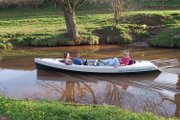
Tuesday, June 19, 2007

Bristol Harbour

Sunday 17th June, 2007, signalled a change in the weather from monsoon to simply overcast. It wasn't settled enough for a long trip, so we decided to "do" Bristol Harbour. On the map this looked good for a short jaunt - no great distance, but plenty to see, and other things to do if the forecast proved wrong. Winsome was loaded up, we set off and arrived at Bristol Marina about 90 minutes later.

The marina is to the west of a large boat-yard and the S.S. Great Britain, on the southern side of the harbour. They have built a lot of houses here in recent years, and there are frequent water buses and ferries to the town centre and beyond. This end of the harbour also sees a lot of water sport activity, and there were dragon boat races between the marina and the seaward end of the harbour.

We were anxious, as one always is on trips like this, that we might not be able to park somewhere quiet enough to get the boat off yet near enough to the water for us to launch. Bristol Marina proved outstanding in this respect. There is a double slipway with ample floating jetty space for mooring along side after launch, and a barrier-controlled car-park for slipway users. This was all included in the £7.50 launch fee which includes the necessary day licence to use the harbour. This probably compares favorably with a long stay car park in the city centre!

We bought our licence from a very helpful lady at the marina office and found a quiet corner of the car park to unload and assemble the boat. We were on the water 30 minutes after arriving.

Marina SLipway

Setting Out

Bristol has a "floating" harbour held at high tide level, so boats float all the time. The tide rises up the river to a point where you can get out to sea for only a relatively short period each tide, but quite large boats can still make it right up to the centre of Bristol. Historically, the city was built around its harbour and it is still a focal point even though Bristol has not been a major commercial port for more than 100 years. Unlike Cardiff, a major commercial port in more recent times, Bristol still "faces" its harbour. As you proceed out of Bristol city centre up the river you can still find "backside" water frontage, but even this is slowly being converted to, or replaced by, homes and offices that face the water. This is good news for Winsome, and for residents and office workers in central Bristol.

Bristol Harbour Map

Also good news in terms of exposure are the large numbers of visitors. Bristol Harbour is a tourist destination with waterborne activities and waterside attractions such as museums and art galleries and the @Bristol exploratory, the S.S. Great Britain and the replica of Cabot's Matthew, theatres, cinemas, cafes, restaurants, pubs and shops. There is ample mooring in the city centre for visiting craft, and there is clearly a substantial resident population living on boats moored in the harbour. And these boats are not, in the main, "posh" - some are quite old and battered, but even the new ones can be interesting.

Because of the dragon boat races, we decided to head "upstream" to the town centre to see what we could find. Looking at the map, we didn't expect this to take very long, but it did. There were two reasons for this: firstly, there is a great deal to see, and secondly the harbour, the river and its feeder canal are much larger and longer than we thought.

We noticed at the outset that we were going much more slowly than we usually do. Rural cruising offers more spectacular scenery, but it changes slowly, so there can be long stretches where there isn't much new to see. In Bristol Harbour, there is something new to see every few yards, and the best place to see it is from the water. We're not very conscientious photographers (you may have already noticed that) but we took more photographs in a couple of hours in Bristol Harbour than we normally would in a month. You'll be pleased to learn that most of them suffered from the poor light and poorer technique, but the fact that we are resolved to get a more up-to-date camera as a result of this trip says a lot.

There are ferries and trip boats plying up and down the harbour, and we noted that some of the newer water-facing offices have jetties to supplement the frequent public water bus-stops. You can well imagine Bristol residents commuting to work at a waterside office in the city centre from one of the residential developments at the western end of the harbour or even, perhaps, from house along the Avon to the east of the city. We haven't seen what the place is like after dark, though, so perhaps getting home from the pub or restaurant after work is more difficult.

Just east of the marina slipway is the marina itself which has extensive moorings for boats that can in principle make it out to sea. We wondered how many of them ever do. In Cardiff Bay, the commodore of one of the yacht clubs reckoned only about 30% of his members ever went through the barrage locks, but Cardiff Bay does provide some sailing area. We guessed that sea trips would probably not be very frequent, if only because it would take a while to get to Avonmouth anyway, and we doubt you'd be able to make a day trip of it.

The next major attraction upstream is the S.S. Great Britain centre - the huge 6 masted ship has its own dry dock and a substantial visitor centre. It was a backup destination for us if the weather broke, but it didn't. All we have are photographs.

SS Great Britain

Beyond the Great Britain on the south side of the harbour are what remains of the working port. There are railway tracks and cranes, but there are also ice-cream stands, a couple of cafes, some loos (with a jetty) and an industrial museum. The high harbour walls give you some idea of the size of boat that was formerly serviced here, and there are some sizeable residential boats. A small boat like Winsome can only land at a few places where there are steps down the water or where there is a jetty. On the north side there is a lot more office and premium residential building, but the same high quaysides predominate. There are, however, some pretty spectacular houseboats moored on the north side. A couple of these were based on what had been fairly sea-going hulls, but I doubt they would now survive anywhere other than secured to a dockside in the floating harbour.

Loo and Poop

Trawler

Even in the city centre, the quaysides are "ship" height, but there are now more floating jetties, some of them accessible to visiting boats like ours, other private moorings protected by security gates. We cruised up past the Watershed building to where the original harbour has now been filled in. We'd never seen the cascading water feature from the water before.

City Centre

This water cul-de-sac is bounded on all sides by eating and drinking places, as well as arts centres like the Arnolfini. We executed a controlled u-turn to the evident delight of the crowd, and returned to the main drag. Turning left under the swing bridge we now proceeded further up the river past floating restaurants and shops.

We made a short detour down to Bathhurst Basin, which must once upon a time have provided another exit point from the floating harbour to the river Avon beyond, but now offers a rather fine marina and residents' moorings for the housing that encircles it.

Bathhurst

Emerging from the basin we turned right to pass under Bristol bridge and pass the old castle park. This would be a good place to stop if you were on a shopping expedition, being the nearest point to the main shopping centre. Above the castle park, the river is closed in on all sides by former dockside warehouses with no obvious quayside where goods were presumably hoisted directly into the buildings. Some of these buildings are now derelict, but others have been or are in the process of being converted to apartment blocks or new offices. There are also some completely new buildings which take more advantage of their waterside location. Whereas the old industrial buildings often present a blank wall to the water, the newly-built ones are clearly making the water an attractive feature. With luck, this will generate demand to make the waterway itself more attractive. In these upper reaches of the harbour there are still a large number of houseboats, but more of these were now conventional canal narrowboats rather than boats that might once have gone to sea.

Development

Bristol is several miles from the mouth of the river Avon, at its (original) lowest crossing point. The river is tidal well inland of the city, but the rise and fall of the tide in the Severn estuary probably made Bristol even in its heyday quite hard work as a port. You'd probably need help coming up the river on the tide, and you'd dry out between that tide and the one on which you left, but the port would at least have been sheltered with decent road access to the midlands. The floating harbour was built around the turn of the 19th century, and required diverting the river to the south of its original course, and putting a couple of big locks on the original channel which opened only at high tide. Netham weir on the Avon to the east of the city maintains the water level in the floating harbour. It also marks the start of the Avon navigation up to Bath from where you can take the Kennet and Avon canal through to Reading and the Thames. Bristol is therefore a canal terminus as well as a sea port, which is presumably why there are so many narrowboats.

As you cruise up the floating harbour into the eastern side of the city, and under the railway bridges at Temple Meads station you are abruptly diverted left onto an artificial "feeder" canal that re-joins the river Avon at Netham. We had already decided to turn round at this point, rather than go through the lock, but when we got there were puzzled to see that the lock was open, and showed no change in level to the river beyond. So it would have been easy to go through and travel the further 4 miles up to the first "proper" lock on the Avon navigation at Hanham. We later learned that Netham lock only closes when particularly high tides on the Avon rise above the level of the weir. In other words, Netham lock and its accompanying weir are designed to preserve the water level in the floating harbour. I guess the sea locks at the Western end of the floating harbour also have to be kept shut at the top of spring high tides for the same reason.

Netham Lock


So we turned round and retraced our wake back to the city centre for a cup of tea and a bun at the Arnolfini before returning down to the seaward end to observe the dragon boat racing at closer quarters. Here we spotted and explored a fine residential development at Pooles Wharf which appeared to have residents' moorings and a rather fine dutch barge.

At Arnolfini

Dutch Barge

It was now nearing 4pm and although the marina offices close at 4, we had been issued with the keycode number to exit the car park. However, just to be on the safe side, we decided to call it a day and proceeded to the slipway to haul the boat out. This was fairly straightforward, although the slipway is somewhat steeper than any we have used before. It's possible we might have been able to recover Winsome directly onto her dolly, but we used the boat roller just in case. We rolled her back to the car park, stripped her down, and were on our way by shortly after 4.

All in all, a great day out and we would have set off earlier had we realised the weather would hold and that access to the river above Netham would be free. We'll do that next time. A final note that struck both of us was how friendly everyone was at Bristol. The marina office couldn't have been more helpful. The harbour master was very welcoming and the numerous ferry and trip boat skippers who passed us all smiled and waved as they went by. The rowing club safety boats supervising the dragon boats were very engaged and engaging, and we had pretty positive interchanges with everyone we met. It must be something in the water.

Sunday, June 03, 2007

Exploring Cardiff Bay

Winsome last visited Cardiff Bay on blustery, wet day in February in order to provide a photo call for the Welsh Assembly’s Waterways Group.

We made a mental note at the time to return in more clement weather to explore the Bay properly. The forecast on Saturday was good so we set off for the Riverside Leisure Centre in Cardiff which (we’ve discovered) is an excellent place to launch and park for the day for only £6.

Leisure centre

Our only challenge on Saturday was the large fleet of kayakers – those in the water were no problem but the empty ones covering the entire jetty made it tricky to bring Winsome alongside after launching.

The map of the Bay below shows our passage marked in red.

Cardiff Bay Map

Half an hour after arrival, we were afloat and pedalling up the River Taff (away from the Bay) in order to view the Millennium Stadium from a novel angle.

Stadium approach

Wales’s football team were playing the Czech Republic which meant we got heckled by large numbers of seriously inebriated red-shirted soccer fans (“Oi, the sea’s the other way mate!”) and peered at suspiciously by the police and security guards parading the Millennium terrace.

Below stadium

Unfortunately, the height of the stadium terrace above the water means that Winsome would probably not be a good alternative for attending International rugby matches. But the novelty of the idea was briefly appealing.


Having exercised a languid U-turn at the main road bridge above the stadium, we had the added treat of hearing the strains of “Mae Hen Wlad Fy Nhadau” as we pedalled our way back past the stadium at precisely 3pm.

Next we headed out of the Taff and round towards Mermaid Quay skirting the outer moorings of the Cardiff Yacht Club. In the Force 4 conditions in February, this stretch of water was memorably rough but we were surprised at the amount of swell across this same stretch on Saturday when the wind was only 2 or 3 at most. At first we blamed the washes of passing Aqua buses and trip boats but the swell persisted for about ½ mile until we rounded the corner towards St David’s Hotel. We wondered if it’s some effect of the current out of the River Taff meeting the still (supposedly) waters of the Bay?

Our hope to impress the patrons of the St David’s Hotel (seated on the balcony for afternoon tea) was slightly dented due to a piloting oversight which meant we grounded briefly next to the wetlands just short of the hotel. A judicious spot of paddling (rather than pedalling) and a slightly heated exchange between helmswoman and crew put this event behind us and we pedalled gracefully into a berth at Mermaid Quay’s very fine ‘Pay&Display’ jetties.

Py&Display

We were particularly delighted to find ourselves alongside a very old wooden Wayfarer complete with rowlock fixed on the stern for sculling. Unfortunately, there was no sign of her crew.

Having paid at the ‘parking’ meter, we enjoyed a brief trip ashore to sample the benefits of city centre life (toilets and ice creams in our case). Mermaid Quay was heaving with city folk enjoying the sun and water and, after 10 minutes of city living, we were glad to escape back to the boat.

Mermaid Quay

After executing a neat stern board exit from our pontoon (which, unlike our grounding, was probably witnessed by nobody), we headed back out into the Bay.

Crossing the main part of the Bay to the barrage was uneventful apart from a couple of bright yellow, high speed RIBs stacked with paying punters screeching with delight at each high speed circuit executed rather closer to us than we would have liked. Watching Winsome bobbing around in their (repeated) wake was probably considered part of the entertainment for the punters. It was less entertaining for us and we guessed that the few small boats sailing found them as irritating as we did. It made us wonder, on such a small stretch of water, how the various very different water-based interests can be amicably (and safely) accommodated. Fortunately, as long as we kept up a good cruising speed and turned bow into the worst of the washes, Winsome took it all in her ladylike stride.

There were plenty of navigational disincentives to inspecting the barrier close up but we enjoyed watching the gates and road bridge open and numerous boats entering and (best of all) the two high speed RIBs boats disappearing through them and out to sea.

Opening barrage

Pedalling past the barrier, we entered the River Ely and passed a Drascombe Lugger drifting lazily in the light and variable winds. The helpful crew told us that we would be fine to explore up the River Ely for several miles until we reached a weir. So, on we went. Either side of the river are new executive riverside apartments – we were hailed with a question by one resident from his balcony high above us but couldn’t identify which balcony it was (there were so many) so the question went unanswered.

Ely Des Res


We noted (with regret) that the apartments offer fantastic balconies overlooking the river but no means for residents to land or keep boats. What a shame.

No mooring


Leaving the housing developments behind, the contrast of the quiet, almost rural river, after the hustle and bustle of the Bay was delightful. We encountered only two other boats and spotted herons and grebes. You start to feel you are miles into the country until the next bend reveals a deserted gasworks or dual carriageway flyover droning overhead.

Pumping station

An unexpected treat was a line of 5 classic old sailing boats (an original Cardiff Bay racing fleet we wondered?). They were in a poor state of repair but had beautiful, old fashioned lines and we just hoped that someone has the funds and plans to renovate them.

5 classic boats

Although the upper reaches of the Ely beckoned (“let’s just see what’s round the next bend?”), we had to keep an eye on the clock and reluctantly turned for home. The Channel View leisure centre had been anxious to point out that they close up shop (and slipway presumably) at 7.30pm.

We made fast progress back down the Ely and the final leg back up the Bay into the Taff and back to our launch point. 3 or 4 cruising boats returning from a day out beyond the barrage motored home past us and commented on Winsome. A friendly steam launch also chugged by and waved. It was nice to chat to passers by not in narrow boats for a change!

Steam Launch

Back at the leisure centre we quickly recovered Winsome, stripped her and had her on the roofrack and ready to drive home in under half an hour.

So, another area of Britain’s intriguing waterways has now been “Winsomed”. Bring on some more.

Monday, May 21, 2007

Sunny Sunday lunchtime run to Llangynidr

Yesterday was a lovely sunny Sunday morning and a good forecast for the day. Llangynidr for lunch, we decided – a 10 mile round trip from Winsome’s “home port” of Pencelli.

We hastily packed all the gear: sunhats, drink, lunch, monster torch and horn (for navigating the Ashford tunnel), The Sunday Times (for the crew to read during the more leisurely stretches of the canal) and portable radio (for keeping up with England versus West Indies test match at Lords). And off we go. Heading Home

Between Pencelli and Talybont-on-Usk (our regular evening pub run), there are 3 drawbridges. Only one of them gets left down in the summer and, fortunately, it’s one that we’ve recently discovered we can shoot (just) if we get both heads (and knees) down to gunwale level – mistakes in height assessment can be painful and the crew needs implicit trust in the helmsman for the signal to “Duck now”!

After Talybont, the next challenge is the 375 yard Ashford tunnel which is very narrow and has no towing path. Apparently, the horses were originally led over the top whilst the boat was legged through. The first photo gives a feel for how dark it is once you are inside. Ashford tunnel

Winsome’s regular helmswoman discovered early on that keeping a straight and steady course through a pitch-black tunnel was not her forte and to retain domestic harmony, she now hands control to Winsome’s tunnel pilot who has turned the practise into his own specialism. You can see him in action here complete with torch. Tunnel pilotThe regular helmswoman (now crew) concentrates on sending out intermittent blasts on our old, but very loud, horn. The darkness and narrowness, combined with Winsome’s silent propulsion, concentrates our minds on keeping narrow boats well clear of entering the tunnel until we are through. One time, we tried following a narrow boat through the tunnel but will avoid doing this ever again. Inhaling their engine fumes was unpleasant, it was noisy, we were repeatedly thrown off course by their (considerable) water displacement and it took about twice as long as when we nip through ourselves at only a little less than normal cruising speed. A lesson learned.

Back out into the warmth of the sun and on to Llangynidr. Work HouseFortunately, the Mon & Brec canal is never very busy and we only passed two other boats (easy) and had to overtake one (bit harder). We find two main problems in overtaking narrow boats. The first is getting them to notice you coming up astern but without creating unnecessary anxiety – a polite “hello” doesn’t usually get heard. A short toot on our fine horn would work but feels rude. Once into the manoeuvre, we can put on a 5mph burst of speed and get past in no time at all. The problem is that, if the narrow boat crew only notice you as you start to draw alongside, they tend helpfully (they think) to steer into the bank (to create more room for us) but, of course, this swings their (hefty) stern out making our passage a lot more hairy. The most effective approach is simply to cruise cheerfully by shouting “stay as you are, stay as you are”….

Just above the first lock at Llangynidr is a lovely peaceful mooring spot and this is where we stopped for lunch. This time we had our own picnic but the very fine “Coach & Horses” pub is only 10 minutes walk down the tow path and that is sometimes our favoured option.

The final photo shows the tunnel pilot (replete with picnic lunch) roping Winsome round ready for the 5 mile trip home. Roping roundWith a bit of luck, this will include an ice cream stop at Talybont…….

Monday, May 07, 2007

Llangollen Revisited

With a spell of fine weather promised, we decided to try the Llangollen canal again. We booked into a canalside B&B near Froncysyllte, where we could tie up for the night. We couldn't launch there, but we could at the "slipway" at Froncysyllte, on the southern end of the famous Pontcysyllte aqueduct . This slipway is clearly not designed for launching, as you can see, and it isn't marked on the British Waterways maps as a slipway. Our host at the B&B thought it had been installed for the benefit of the ducks, and other wildlife, who cannot otherwise get in and out of a canal that is concreted for long stretches.

Slipway

Once in the water, we scooted across the aqueduct


and back to make sure we had everything in place for the major passage the following day. The northern end of the aqueduct at Trevor is a narrowboat hire company base . We threaded our way through the moored boats to the pub.


Trevor Narrows


This must be quite an exciting place to be when the hiring week starts. What with the aqueduct in one direction and the very narrow Llangollen canal in the other, it must take quite a while for everyone to disperse. After a quick drink, we re-crossed the aqueduct and then repaired to Chirk (by car) for an excellent curry.

The following morning we set off from our B&B, crossing the aqueduct unimpeded. This was useful because the aqueduct is strictly one boat wide, the canal can be pretty busy, and narrow boats proceed even more slowly than usual across this engineering marvel - it must be something to do with the altitude.

We turned left at the nothern end and set off up the Llangollen arm of the canal, which clings to the sides of the Dee valley. It was originally intended mainly to feed water into the canal from the Horseshoe falls above Llangollen, and since it wasn't therefore primarily a commercial waterway, it is very narrow in places. The canal is still a major supplier of water to some towns in Cheshire, which probably helps to keep it in good condition. There is therefore quite a water flow, but we were pleased to note that this was having little effect on Winsome - we were able to maintain our usual 4mph without additional effort. The flow is certainly greater than it is on the Mon & Brec, but the waterway is also quite a bit deeper for the most part, so I guess the power required to push the boat along is probably comparable.

There are two sections between Trevor and Llangollen where two boats cannot pass. There is no signalling system and the signs advise you to send someone ahead to ensure the canal is clear (and stays that way) before entering the sections. We were held up on the upper section - about 500 metres - waiting for a boat coming downstream. This place must be a nightmare on busy days.

When we got to Llangollen, which took us just under an hour, we tied up outside the British Waterways booth where you buy tickets if you plan to moor overnight. The very friendly BW officer remembered another pedal boat from last year, and gave us this photograph of it.

Another Pedal Boat

It looks rather fine, with two pedalling stations and a good deal more storage space than Winsome. We hope we encounter it again. The BW guy said we ought to be able to get up to Horseshoe falls - where the canal takes water from the Dee - but we would need to watch out for the only boat that normally proceeds beyond Llangollen, the horsedrawn trip boat.

We walked into the town to buy some sandwiches and ginger beer for lunch, and then set of westwards towards the source of the canal. Just above the main Llangollen quays, and opposite the International Eisteddfod field, there is a new marina where about 20 narrowboats can tie up for the night. Since this was early in the season, there were only a couple moored there when we went past. Narrow boats have to turn round at this point - above the marina the canal is narrow and shallow but (more importantly) there are no "winding holes" where 60 or 70 foot boats can turn round. There is even a sign forbidding boat traffic from travelling up the feeder, but we had been invited by the BW manager for Wales and North West England to proceed to the source, and BW at Llangollen seemed happy for us to proceed.

The canal above Llangollen is wide enough for boats to pass, but because it gets very little traffic apart from the horse-drawn trip boat, it is shallow near the banks in many places. BW clearly do not expect motor boats on this stretch, although organised parties of canoists are welcome. We passed the horse-drawn trip boat about halfway up, and managed to stay well out of its way.

Here's the horse:

Horse Boat Horse

and here's the boat, with a troop of what looked like junior scouts aboard:

Horseboat

The boatman obviously doesn't encounter many other boats on this stretch! The horse-boat is quite long but it is double-ended and you can move the entire rudder and tiller from one end to the other. This enables the boat to proceed pretty well as far as we did - to the hotel just below the Horseshoe falls.

We arrived at the terminus at the famous Chainbridge hotel about 30 minutes out from Llangollen, and immediately saw that the warnings about not being able to turn round were quite serious. We knew that, if necessary, we could lift the bow out of the water to turn the boat, but the concrete banks are quite high, and the water flow is more pronounced at this point.

The friendly manager came out to see what was happening, and between us we found a spot - just outside the door to room 44 if you want to repeat this feat - where you can rope a 17+ foot pedal boat around. Fortunately, although the canal is very narrow it is also quite deep - there was therefore little risk of grounding the boat while turning her round. With Winsome pointing in the right direction for the return trip, we rewarded ourselves with a drink from the bar and a look at the falls.

Outside room 44

We timed our return to avoid the horse boat, due to make its next trip at 2pm. Even so, we managed to stop on the way to eat our sandwiches and bask in the sun. The GPS showed that we were making about 1/2 mph more going downstream, and we arrived back in Llangollen pretty quickly. Things looked quite quiet on the canal so we decided to sprint through the first narrow section and hope for the best. This was a mistake. About 200 metres into the thing we encountered a hire boat coming towards us and decided to retreat. We may have been unnecessarily anxious about the flow, because we opted to tow Winsome backwards up the canal from the bank, rather than pedal her. This, it turns out, is not terribly easy to do - the rudder becomes a largely unhelpful encumbrance to sternward motion, and we could see why narrow boat rudders often have a small "eye" visible above the surface, no doubt for attaching towing roped under exactly these circumstances. But with much bumping and cursing, and help of someone from the oncoming boat, we managed to tow Winsome back to a passing place.

Our early hubris having received its just desert, we re-navigated this narrow stretch "by the book" with one of us jogging ahead along the towpath until we could see the way clear ahead. This means (a) proceeding 300 metres to a bend and beyond before returning and waving Winsome through and (b) one of us having to pedal the boat unaided through the narrows. Despite this unhappy conjunction of circumstance, the passage was made without mishap. The solo pedaller, aided somewhat by the flow, managed a record-breaking sprint over the 500 metres that almost left her breathless. Fortunately, the other narrow section has passing places at visible intervals and could be navigated under full power. Needless to say, it was quite empty.

Solo SPrint

The remainder of the trip back to the aqueduct proved uneventful and relaxing. We passed some boats coming up but none going in our direction. When we arrived back at Trevor, we stopped for an ice-cream before setting off back over the aqueduct for the last time .... or would have, but for a convoy of nicely spaced out narrow boats coming in the other direction. A narrow boat takes a loooong time to cross the Pontcysyllte aqueduct, and it seems even longer if you are waiting. It needs traffic lights!

When the last boat had come across, we sprinted for the aqueduct to book our place, and shot across at indecent speed. We need not have worried - the canal was now quite quiet again.

Back on the aqueduct

And thus we arrived back at our slipway after an epic 12 mile (or so, according to the GPS) voyage, and tied up alongside. We decided to strip the boat while afloat, because we were not entirely sure how we were going to get her out of the drink. As you can see from the picture above, the slipway shelves relatively steeply (good) but reverts to a regular canal bank about a foot from the water's edge (bad). The challenge, therefore, was to get the bow out of the water and clear of the step and hope that we could drag the boat ashore before the rudder grounded.

We had brought two boat rollers just in case, and inflated both of them. The bow lifted easily enough and Winsome could be pulled ashore onto the first roller on the top of the step then pulled up the grass slope of the canal bank a little way before inserting the second roller. Things were going reasonably well when it became apparent that the boat was rolling off the top most roller and the bottom roller decided to detach itself and disappear down the canal to Chirk. A friendly passer-by retrieved the roller and we managed to regain control of the boat by some inelegant shoving and a fair bit of cursing. All in all not the most graceful recovery we have done, but not something we wouldn't attempt again, either.

All in all a delightful trip, and one we are keen to do again, but we would counsel any other Winsomers to avoid busy times of the year or of the hire boating week. Narrowboating is relaxing only if you are the narrowboater.

Friday, April 20, 2007

The Empty Monty

On Tuesday April 17th, we went to Welshpool on the Montgomery canal - affectionately known as "The Monty" - partly at the invitation of the Powys Tourism Services Unit. They are charged with promoting this wonderful waterway as a tourist attraction, and wanted us to see if the canal was any good for Winsoming.

The canal is a very old one, originally connecting the agricultural heartlands of Montgomeryshire with the Llangollen Canal at Frankton. Like many canals, it went into decline very early in the railway era, and was finally closed to traffic in the 1930's. Since then, it has suffered from some over-building, but long stretches of it have remained "in water" and it has become a tranquil linear water park with a rich flora and fauna. It is now undergoing a revival as long stretches of it are being restored to navigation with the long term goal of reconnecting almost the entire original length to the remainder of the canal system. Welshpool is in the middle of quite a long navigable, but isolated, stretch. There are a few private boats on this stretch, and a couple of trip boats, but traffic is very light. This is the kind of waterway that Winsome was designed to cruise, provided we can launch the boat.

Tonia Parry, our contact at the Tourism Services Unit, told us about the slipway and mini-marina in the main public carpark in Welshpool. This is a modern (re)construction, but it is presumably the site of the original commercial canal "port" at Welshpool. The slipway may be a little narrow for a regular narrow boat, but is absolutely perfect for Winsome. When empty, Winsome's bow is almost clear of the water at the bow, and the Welshpool slipway is very shallow at the landward end, shelving steeply from about two feet into the water. This meant we could launch Winsome easily without getting our feet wet. There is a road down from the carpark and a turning spot that we used to unload Winsome from the roof rack (see below).


AFter a couple of short runs around the pound for photographs and demonstration, we said goodbye to our friends from the Tourism Services Unit, and set off North for Pool Quay. There used to be a pub at Pool Quay, but this has now closed so we had to stock up with sandwiches and drink in Welshpool.

The canal going North from Welshpool is initially very narrow, and perhaps because there is not a lot of boating traffic at the moment, and very little natural flow to the canal, a lot of floating vegetation has accumulated in the narrow spots. Our progress was somewhat hampered by the need to keep the bow clear of dead, but floating, reeds, which occasionally snagged the rudder and propeller as well. For this reason, our average speed on the Monty was not much more than 3mph, although in the clearer and wider stretches Winsome managed her normal cruising speed. Cruising the Monty is a little like cruising the Mon&Brec at the very start of the season, when all the winter debris and early season bank maintenance has clogged the canal. We assume that on the Mon&Brec this is cleared by the boat traffic when the cruising season gets underway, but BW also do weed clearance runs with an amazing paddle-boat that has a front end like a water-borne combine harvester. Perhaps they don't do this on the Monty.

The canal moves through some lovely countryside, and doesn't twist and turn as much as the Mon&Brec. Outside the town of Welshpool, it broadens out a bit in places, but we were quite glad we didn't encounter any other boats we would have had to pass. This might not be too much of a problem at busier times - if there ARE any of these on the Monty! - because the canal is relatively straight and you can always wait in a wide bit for oncoming traffic.

There are a couple of lift bridges between Welshpool and Pool Quay, and these are much simpler to operate than the hydraulic type we have encountered before. They are finely counter-balanced - see below - and you just pull on a chain to raise them to the vertical position. However, from the Winsomer's point of view, it's important to remember that these balance bridges are only stable when fully open or fully closed. Our normal practice of partially opening those bridges we have to open at all is not to be recommended on the Monty. Having said that, they are much quicker and more satisfying to operate, and you don't need a winch handle.


We arrived at what we thought was the deserted lock at Pool Quay in time for lunch. As it turned out, however, there was a huge boat already in the lock coming southwards. This was the trip boat Heulwen II, (see below) which together with her sister boat Heulwen I operate round the year excursions for the disabled or in this case parties of the elderly. The boats have been specially adapted for wheelchair access, and the trips are free. They don't run at weekends or bank holidays because they are crewed by employees of the charitable trust that own them.


After lunch we explored Pool Quay a little, but could find little trace of the original river port which marked the highest point of Severn navigation. When we returned to Winsome, the trip boat had gone South towards Welshpool, so although this would make our return run somewhat slower, we hoped that Heulwen would at least clear some of the vegetation from the canal surface for us. Alas, this didn't happen, so our return trip was again punctuated by frequent stoppages for reed clearance.


But all in all, a good day. On the drive home, we checked out a more southerly stretch of the Monty above Berriew. We had been warned that this might be even weedier, but it didn't seem to be. We could get there from Welshpool, although we would need to pass through a few locks to do so. We're going to come back some time to try this stretch.

The Monty is a great cruising ground for an experienced Winsomer, though a bit challenging for the beginner. If the Monty were more popular with boats, no doubt its water would be clearer for navigation in a low power propeller driven craft like Winsome. But then it would probably lose some of its charm, and it would not be the haven for wildlife and vegetation it is today.

Wednesday, April 18, 2007

Winsome at Saul Junction

The Saul Canal Trust is keen for us to bring Winsome to their 2007 festival at the end of June. Understandably, they were anxious to check the boat out first from a safety point of view, given that we are keen to encourage members of the public to try the boat out.
So, on Easter Monday, we took the boat to Saul junction on the Gloucester and Sharpness canal to let the festival organisers try her out.

Saul is a lovely spot, the canal is surprisingly wide and the sight of interesting passing boats instantly gives the keen Winsomer a hankering to get on the water and go places – upstream to Gloucester docks or downstream to Slimbridge and Sharpness.

First of all, we gave a number of Canal Trust members a go in the boat. They were all narrow boat owners but seemed enthusiastic about the different, more flexible and slightly more active experience which Winsome offers even a seasoned narrow boat owner. The comfort of Nick’s reclining seats and the touch sensitive tiller attracted particular praise!

Promising to return later, we then set off downstream to Slimbridge where we had been promised we would find ‘The Black Barn’ café.


There are numerous bridges over the canal with operators on duty and a red/green traffic light system in operation. It transpired that the system was for powered boats only and we discovered that the operators tended to ignore us in the hopes (probably) that we could squeeze under the bridges without the hassle of them opening them. Fortunately, we found that this was indeed the case although squeeze was an apposite term – we developed a technique of pedalling fast up to the bridge with the crew trustfully relying on the helmswoman shouting “DUCK” just before his head hit the oncoming bridge. We both then slid down in our (very comfortable) reclining seats until our heads were just above the gunwale and shot the bridge in impressive fashion (continuing to pedal risked banging our knees!).

Apart from shooting bridges, much of the interest (to us anyway) on this canal was the other boats, including huge commercial barges.

After 50 minutes, we arrived at the Black Barn café and moored alongside and purchased a welcome cup of tea and sausage roll. The photo shows the skipper consuming the same.


The return trip to Saul passed without incident. The GPS showed Winsome travelling significantly faster (when we pedalled at our ‘normal’ cruising speed) than on our considerably narrower and shallower home waters. We had noted this effect on Lake Windermere previously. The Mon & Brec canal is only 4 foot deep and very narrow and one can see (let alone feel) the volume of water which Winsome (and her pedallers) have to displace in order to move along.

After providing more Canal Trust members with go’s in Winsome, we reluctantly took the boat out to go home. But our appetites are now whetted for a passage to Gloucester docks – and even maybe linking through to the River Severn and up to Tewkesbury – an overnight passage beckons….

Reflections on a Canal


This fine picture is of Winsome on the Monmouthshire and Brecon canal, being pedalled at a leisurely 4mph by Drs Kidd and Williams. It shows the boat quite well. The canal that day was rather muddy and opaque, but it was a fine day and the light was good, making for a very good (i.e. coherent) reflection off the surface. Winsome generates very little wake, but a wake is notoriously difficult to photograph. This photograph shows the structure of Winsome's wake rather well, with the whorls in the water creating the "illusion" of some post-processing with something like Photoshop, when the effect was completely "natural".

Here is another one which shows the wake rather better, although the distortion in the reflection is not quite as pronounced.


Friday, March 02, 2007

Winsome’s Day Out at The Welsh Assembly


The Welsh Assembly run an all party ‘Waterways Group’ in partnership with British Waterways. The group’s brief is “Improved Quality of Life through the Sustainable Development of the Waterways of Wales”.

We had been invited by Marc Evans of Civitas Cymru to give a short presentation on Winsome at the next meeting of the ‘Waterways in Wales’ group on March 13th.. Winsome is certainly about “quality of life” on the Welsh Waterways, she definitely represents a sustainable mode of transport and, most importantly, she provides a perfect alliterative fit to the Group’s title! Maybe this is why Marc also asked if we’d be happy to make Winsome available for a photo call with Val Lloyd, the Assembly Member who chairs the working group.

So, Tuesday morning (February 27th) found us pedalling furiously in a blustery Force 4 and intermittent driving rain, across the broad expanse of Cardiff Bay headed for The Welsh Assembly. The Cardiff Bay Harbour Authority had been signed up to look after us for the morning and their friendly and helpful wardens did an outstanding job – from greeting us on the River Taff slipway until shepherding us home 3 hours later on a very rough and wet windward passage back across the Bay. By this time, despite the generous provision by the crew of a large (and fairly clean) handkerchief to dry the helmswoman’s spectacles, identifying the navigation buoys at the entrance to the Taff river had become a serious challenge.

This was probably the roughest conditions we have experienced in Winsome (although the nautically-robust Newlands have surfed in over a lively Cardigan Bay bar before now). We were really pleased with how stable she felt and how little “green stuff” we shipped. With the flow out of the river Taff, we also set off at a surging 5mph leaving the Harbour Authority power launch surprised to discover what it took to keep up with us!

Twenty minutes or so later, we arrived safely and tied up at the ‘Pay&Display’ jetties below the Senedd and retired (with our harbour authority friends) for a hot cup of Cappuccino before returning for the photo call with Val, Marc and friends. Val is not a boater but enjoyed (we hope) experiencing a craft which was dry and stable, had comfortable reclining seats and didn’t immediately demand any insider knowledge or specialist jargon. We just felt sorry not to able to give Val a more gentle introduction to Winsoming in the altogether calmer waters of Winsome’s home port - the Mon & Brec canal at Pencelli. Although it rains as much here as in Cardiff, our 20 foot wide canal struggles to develop any decent waves even in a gale!

Photo call over, it was back to the café for an enjoyable lunch learning about Marc Evans’ interesting company, Civitas Cymru – then, lifejackets, waterproofs and hats back on and out into the driving rain and wind for our return passage under the ever watchful eye of our patient Harbour Authority friends. As we busied ourselves sponging the rainwater out of Winsome’s bilges, they asked us (politely) whether we would prefer a tow home but my late father (a life-long sailing man) would have turned in his grave at the idea of his daughter accepting a tow simply because of adverse weather conditions – no, it was Winsoming back across the Bay for us into the strengthening Westerly wind and, as ever, we enjoyed it.

We also discovered just how quickly we are able to get Winsome out of the water, stripped down, loaded onto the roofrack and lashed down when it’s pouring with rain and we are both 100% focussed on getting home as soon as possible for hot showers and tea!

Tuesday, February 27, 2007

Winter Winsoming on Windermere


For a couple of days in mid January, we rented an historic cottage from the National Trust on the shores of Lake Windermere complete with its own stone jetty. The cottage – Low Strawberry Gardens – got its interesting name from a period during which the owner catered for a water-borne market in strawberry teas for Bowness-based tourists in the 19th century.

We were able to launch Winsome (somewhat spectacularly) from her dolly over the side of the jetty. Although the jetty is also a slipway, when it reaches the water it degenerates into an irregular pile of rocks, preventing a more normal launch.

We had a GPS to monitor our speed and noticed straight away that we were going about ½ mph faster than we do on our canal. Although we hadn’t expected this, it makes sense because on a narrow canal I guess you expend energy moving the water along the channel, and on open water I suppose this effect is much less. In any event, for the same (low) energy input we were able to maintain a steady 4.5mph on Windermere, whereas we tend to cruise at 4 to 4.1mph on our canal.

Flush with this discovery, and freed (so we thought) from speed limits, we tried a short sprint. We found we could do 6.5mph fairly readily and peaked at 6.8. Not bad. We later learned that there is a speed limit on Windermere: 6mph where we were and 10mph elsewhere on the lake. Fortunately, our high spirits went (we have to hope) unnoticed by the authorities. In any case, true to form, Winsome leaves no discernible wake – which is more than can be said for the passenger boats that ply up and down the lake every day throughout the year.

The next morning dawned bright and clear and, in a gesture of majestic blasé, we decided to nip across the lake to Bowness before breakfast for our morning paper. This took about 15 minutes, or would have done but for a minor pilot error which saw us coasting merrily inside a perfect circle of hazard buoys. We managed to reverse out unscathed, grateful that the manoeuvre would not have been widely observed at 9:00 am on a January morning. Fortunately, reversing in a dead straight line is pretty easy in Winsome.

After returning to our cottage for a sumptuous breakfast (complete with morning paper), we set off again in Winsome northwards to the top of the lake, a distance on the chart of about 5 miles. The weather was mainly cloudy, with patches of sun that rarely seem to include where we were

It took us just over an hour to reach Waterhead. The lake was deserted on the way up except for the passenger boat that runs regularly up and down the lake and creates an exciting wash which, “taken at the flood”, can provide a sensation akin to surfing, but taken at right angles is less comfortable.

We passed a number of properties with wonderful boathouses just yawning for a Winsome. One of these is Wray Castle – a Victorian construction with turrets and mock castellation – reportedly rented in the summer by Beatrix Potter’s parents when she was a child. It is a much grander property than the house used in the recent film, and even in the 19th century must have cost quite a bit to rent. But perhaps property rental at that time was not so much a commercial venture for the landlord – more a way of offsetting the cost of running his own country house.

We tied up at the jetty at Waterhead and went in search of a light lunch…

We returned to Low Strawberry Gardens late afternoon and lit a large log fire!

The following day dawned somewhat murkier than the previous one, with a very light drizzle or mist and indifferent visibility. We decided that we would still go fetch our paper, and something for our tea – which we thought at that stage we might well be taking early. Our passage across to Bowness was uneventful, but definitely damper than before.

Given the damp weather (but not wanting to miss out on exploring the lake), we decided to pedal right down the lake to the Southern end and land for tea (hopefully) at the rather grand Lakeside hotel.

This was a lengthy passage with persistent light rain and a westerly breeze of variable strength. The lake was pretty calm the whole way. We were trying out yet another cheap poncho we had bought in Ambleside, and yet again it did not quite work. The waterproof trousers did, however, keep our legs dry and we looked quite a bit wetter than we actually were.

After about 80 minutes of easy pedalling clocked at a steady 4.4 mph, we arrived at the Lakeside Hotel which, in its own words, “overlooks nothing but the lake”. We barged into their very fine conservatory bistro overlooking the lake looking like drowned rats and asked as confidently as we could for some tea. No problem. Tea for two at the Lakeside is £6 but this includes 4 pieces of ginger-flavoured shortbread biscuits to die for. I would personally have plumped for one of their enormous open sandwiches, but my partner was not feeling hungry enough.

We returned to our cottage about 4 and fetched Winsome out of the water at the nearby wooden jetty and beach in order to load her up for the trip home while it was still light.

From the Swan Hotel at Newby Bridge in the South to Ambleside in the North, Windermere offers a good 13 miles of cruising, a decent day out for Winsome if you are able to stay the night at the other end. For everyone else, the perfect spot is exactly halfway up the lake, where a full day’s cruising with stops will take you to either end and back. You really should try it, especially if you have a Winsome. It’s even enjoyable in January.